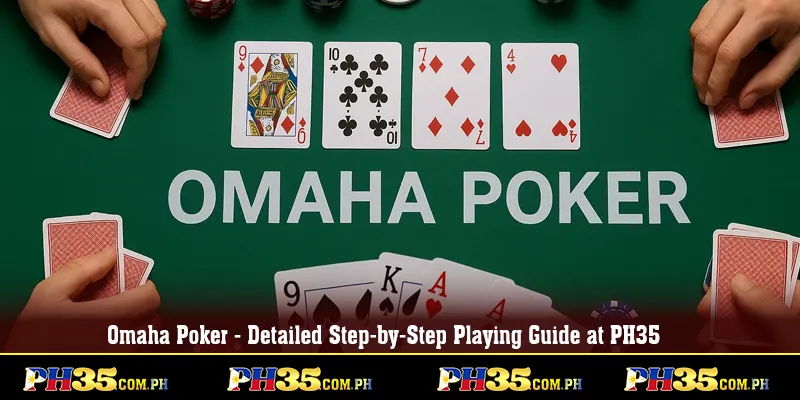
Omaha Poker stands as one of the premier strategic card games across online entertainment platforms. Featuring dynamic gameplay mechanics and requiring deep analytical thinking, this poker variant consistently draws a large player base. This article helps you master fundamental game rules alongside essential strategies to take command of every betting table at PH35.
Fundamental Concepts You Need to Know
To launch your journey effectively, understanding the core nature and rules of Omaha Poker is essential. Compared to traditional Texas Hold’em, this variant features unique characteristics that heighten suspense during every wagering round.
Card Dealing Mechanics and Hand Combinations
In every match round, each player receives a total of 4 private hole cards. Subsequently, the dealer reveals 5 community cards on the board across sequential betting rounds. A mandatory rule for constructing a complete 5-card hand is that players must use exactly 2 hole cards from their hand combined with exactly 3 community cards from the board.
Popular Game Variants
Two primary Omaha Poker variants are widely featured at PH35:
- Omaha High: The player who constructs the strongest high hand according to standard poker rankings claims the entire pot.
- Omaha Hi-Lo (8 or Better): The pot is split equally (50/50) between the player holding the highest hand (High) and the player holding the qualifying lowest hand (Low).

Detailed Round Procedures in a Poker Match
A standard Omaha betting round unfolds across 4 official wagering phases. Mastering this sequence empowers you to make well-timed betting decisions.
Pre-Flop and Flop Rounds
- Pre-Flop: Begins immediately after all players receive their 4 hole cards. The two players seated to the left of the Dealer post forced bets (Small Blind and Big Blind). Subsequent actions—raising, calling, or folding—proceed clockwise around the table.
- Flop: The dealer reveals the first 3 community cards face-up on the board. Players analyze potential hand combinations to navigate the second betting round.
Turn, River, and Showdown Rounds
- Turn: The 4th community card is revealed face-up. Bet sizes often escalate during this phase to exert pressure on opponents.
- River: The 5th and final community card is revealed. This marks the final window for players to complete their 5-card hands and execute decisive wagers.
- Showdown: Active players remaining in the pot reveal their cards for comparison. The player holding the strongest valid 5-card hand combination wins the entire pot balance.

Effective Omaha Poker Strategies from Experts
Because players start with 4 hole cards, the total number of potential hand combinations is significantly higher than in standard poker. Implementing a structured strategy is paramount to sustaining a long-term edge.
Selecting Starting Hands Wisely
Not all 4-card starting hands are worth investing in. Prioritize starting hands featuring high connectivity—such as large pocket pairs (AA, KK, QQ), suited cards for Flush draws, or connected cards for Straight draws. Avoid playing uncoordinated hands that lack synergy.
Bankroll Management and Emotional Discipline
Holding 4 hole cards introduces higher variance compared to standard card games. Establish strict wagering limits for every session and adhere strictly to capital preservation rules. Stay composed and avoid letting emotions drive decisions during losing streaks.
Conclusion
Omaha Poker delivers a top-tier entertainment experience while offering a great environment to refine your strategic thinking. Joining the action at PH35 ensures a transparent, professional, and secure gaming space. Refine your skills, apply tactical strategies, and master the poker tables today!